
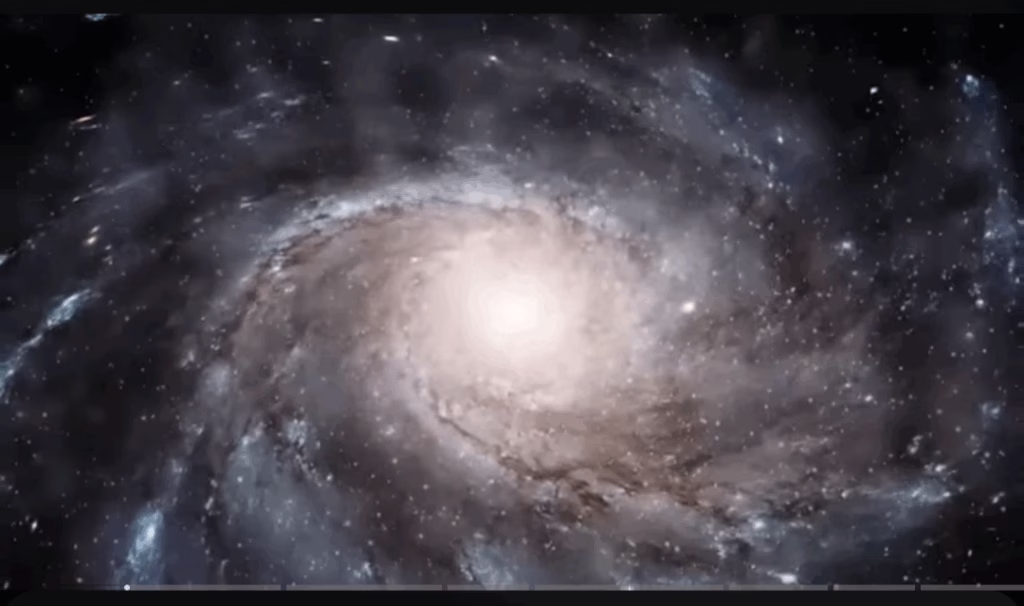
This image shows a spiral galaxy, very similar in appearance to our own Milky Way. Here’s a breakdown of what’s going on:
🌌 What You’re Looking At
- Galactic Core: The bright, glowing center is the galaxy’s core. It’s densely packed with stars and likely contains a supermassive black hole at the very center.
- Spiral Arms: The arms spiraling out from the center are made of stars, dust, gas, and dark matter. These regions are where a lot of star formation happens.
- Dust and Nebulae: The darker, reddish streaks are cosmic dust lanes. These absorb and scatter light and often obscure parts of the galaxy behind them.
- Background Stars & Galaxies: The tiny bright dots scattered across the background are other distant stars or even whole galaxies.
🌀 What’s “Happening” in this Image?
This is a snapshot of a galaxy in a relatively stable state, though in cosmic terms, there’s always motion:
- The entire galaxy is rotating—stars closer to the center orbit faster than those farther out.
- Star formation is occurring in pockets along the spiral arms.
- Gravity holds everything together in a dynamic balance, with the help of dark matter, which provides the extra mass needed to explain the observed rotation.
🎨 Is This a Real Image?
If this is a still from a video or animation, it may be a rendered simulation or enhanced image. While we do have real telescope photos that look similar (e.g., from Hubble or James Webb), many public images are color-enhanced or artistically interpreted to help visualize different wavelengths.
This image shows a spiral galaxy, very similar in appearance to our own Milky Way. Here’s a breakdown of what’s going on:
🌌 What You’re Looking At
- Galactic Core: The bright, glowing center is the galaxy’s core. It’s densely packed with stars and likely contains a supermassive black hole at the very center.
- Spiral Arms: The arms spiraling out from the center are made of stars, dust, gas, and dark matter. These regions are where a lot of star formation happens.
- Dust and Nebulae: The darker, reddish streaks are cosmic dust lanes. These absorb and scatter light and often obscure parts of the galaxy behind them.
- Background Stars & Galaxies: The tiny bright dots scattered across the background are other distant stars or even whole galaxies.