
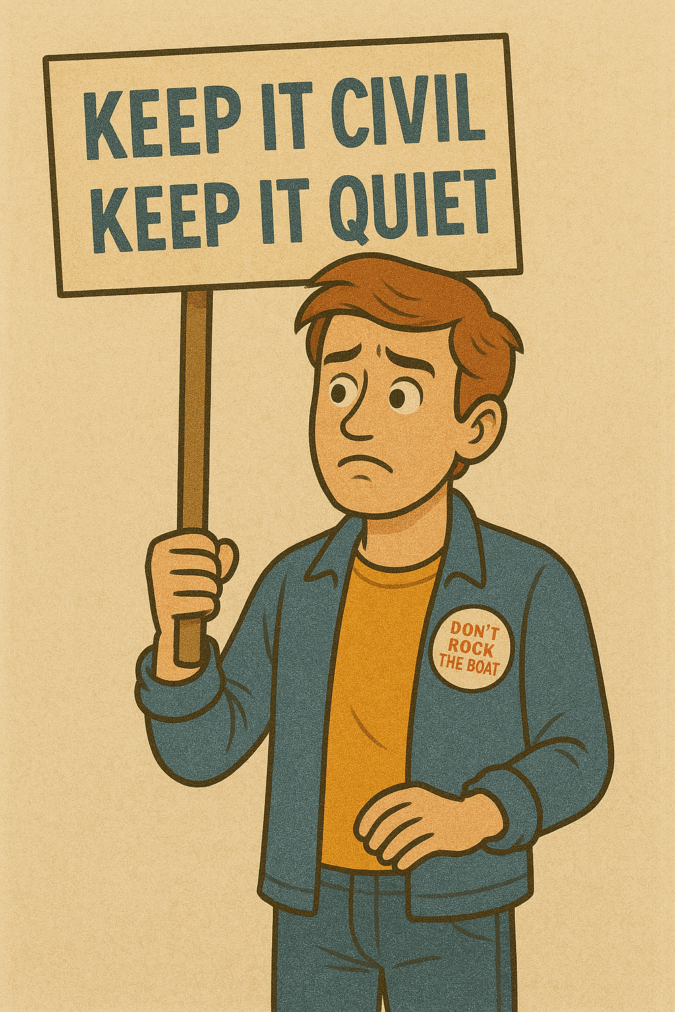
The idea of “polite society” refers to an old-school social code. It is usually followed by upper or middle-class people in Western cultures. This code promotes decorum, civility, and smooth social interaction. It does so by avoiding topics that are likely to cause disagreement, discomfort, or drama.
Core Concept:
Polite society is not about honesty or truth—it’s about not making a scene. It’s about being pleasant, non-threatening, and neutral. This helps to keep the peace at dinner parties, office meetings, and other “mixed company” situations. It values social harmony over personal expression.
The “Forbidden Topics”:
Historically, these are the Big Three:
1. Politics
- Why: People tend to have strong opinions, and political discussions can quickly escalate into arguments.
- In polite society: You don’t talk about who you voted for. Avoid discussing what policies you hate. It’s best not to mention what the government is doing wrong—especially not at brunch.
- Underlying fear: Openly discussing politics might reveal class, race, or value divides, which threatens the illusion of shared civility.
2. Religion
- Why: Beliefs about God, the soul, morality, and the afterlife are deeply personal—and often incompatible between people.
- In polite society: You can mention that you went to church, but don’t preach, convert, or criticize other beliefs.
- Underlying fear: Religious debates can unearth bigotry, trauma, or tribalism—none of which go well with hors d’oeuvres.
3. Money
- Why: Discussing wealth (or lack of it) reminds people of inequality, privilege, or personal failures.
- In polite society: You don’t ask someone’s salary, brag about how much you make, or complain about being broke.
- Underlying fear: It breaks the illusion that “we’re all just regular folks,” which is key to keeping conversation non-threatening.
Other taboo topics in polite society:
- Sex (unless joking)
- Death (unless someone died and you’re being sympathetic)
- Bodily functions
- Trauma or mental health
- Anything that makes someone feel something strong
Why did this code develop?
It grew out of:
- Victorian ideals of manners and social class.
- Post-war American norms, where keeping up appearances was survival.
- White, Western, Protestant values that prized restraint and “good breeding.”
It was essentially a method for people to coexist peacefully in shared spaces. This was particularly important in societies that were already divided but pretending not to be.
The Downside:
- It suppresses authenticity.
- It protects privilege (only works when everyone already benefits from the status quo).
- It excludes marginalized voices—those for whom politics, religion, or money are not abstract topics but daily realities.
Today?
Polite society is fading in some places and fiercely defended in others. In modern settings—especially online or in activist circles—it’s often viewed as a cover for cowardice, avoidance, or complicity. But in certain professions, families, or cultural pockets, it’s still the gold standard of “being a good person.”
If you want to survive polite society:
Keep it light, keep it surface-level, and keep your convictions to yourself.