“She Saved String, I Streamed Porn: Notes on Growing Up Two Generations Apart”
By someone born in 1973, raised on microwaves, and confused by lace doilies
When I was a kid, my grandmother used to wash Ziploc bags.
Yes, wash them.
Like soap, rinse, dry-on-the-rack wash them. If they had a zipper, it was reused until the apocalypse. Sometimes, it melted into a radioactive puddle on the stovetop. This happened more than once.
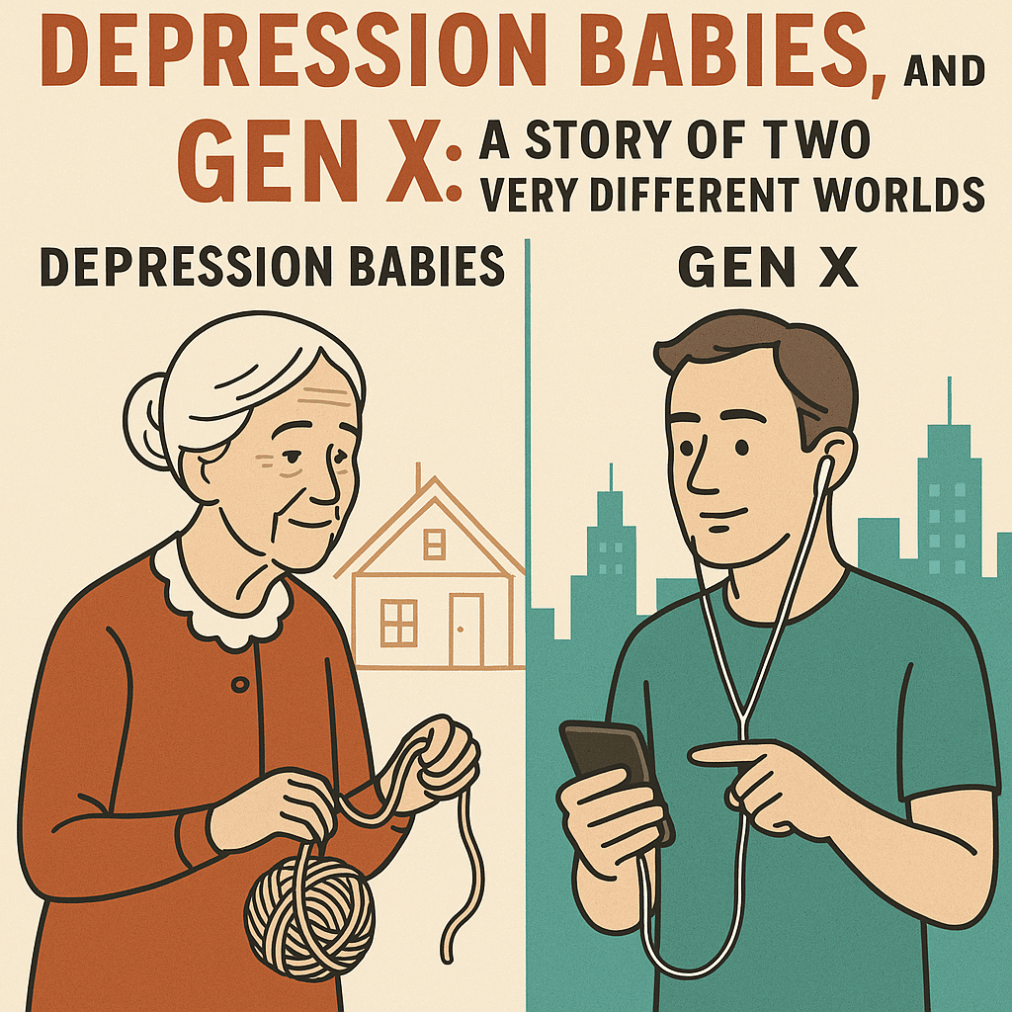
She was born in 1918. Let that sink in. Woodrow Wilson was still president. The Titanic was recent history. The Spanish Flu was killing people like it had a vendetta. Her life started when horses were still a viable transportation option.
Meanwhile, I was born in 1973—the year of disco, Watergate, and Tang. A time when people still smoked in hospitals and thought margarine was good for you. We are, to put it mildly, from different planets.
Scene 1: The Toast Confrontation
“Why do you burn your toast like that?” she asked one morning, frowning at my blackened slice like it was a moral failing.
“Because I like it crunchy,” I said, taking a bite.
She shook her head. “That’s not toast. That’s punishment.”
Then she handed me a knife. Her sigh seemed to say your generation is weak. She implied that you’re probably going to die cold and alone.
DIFFERENT BRAINS, DIFFERENT RULES
To her, life was duty. You didn’t chase your dreams. You got a job and clung to it desperately, like it was the last raft on the Titanic. You married young. You kept your mouth shut. You didn’t talk about feelings; you just shoved them into your bones and hoped they didn’t give you ulcers.
She lived through the Great Depression and a world war. She also saw several presidents who believed cigarettes were good for the lungs. She had no time for whining. If you cried, you’d better be bleeding. And even then, stop bleeding so much—it’s wasteful.
I, on the other hand, grew up with therapy commercials on daytime TV. We had cereal for dinner. Our parents told us we were special. They chain-smoked Virginia Slims out the car window. We were the latchkey kids of late-stage capitalism. We had feelings. Lots of them.
Scene 2: A Question Too Far
Once, as a kid, I asked her, “Did you love Grandpa?”
She stopped darning socks (yes, darning) and looked at me like I’d asked if she was a lizard.
“Love?” she repeated. “What’s that got to do with anything? He worked. He didn’t hit me. We had food.”
End of discussion.
Meanwhile, I’m over here in the ‘90s. I’m trying to figure out if my relationship is “emotionally nourishing.” Maybe it’s just “rooted in unresolved childhood trauma.”
TECHNOLOGY: FROM RAGS TO RINGTONES
She thought television was dangerous and microwaves were witchcraft. I grew up with a remote control as a third hand. My Walkman chewed up my favorite mixtapes like a hungry dog.
She got her news from the evening paper. I get mine from a Reddit thread that may or may not have been written by a Russian bot. She believed what Walter Cronkite said. I Google things like “Is the moon fake?” and “Did birds used to be government spies?”
VALUES: THE “SHUT UP” GENERATION MEETS “SPEAK YOUR TRUTH”
She believed in respect, hard work, and never airing dirty laundry.
I believe in boundaries, therapy, and posting my trauma on the internet for likes.
She made do with what she had. I order things I don’t need at 2AM from a website that delivers them in 24 hours. Sometimes I forget what I ordered. It’s like a gift from Past Me to Future Me. Grandma would have had a stroke watching me scroll Amazon.
Scene 3: Saving the World with Spaghetti Jars
When she passed away, we cleaned out her basement. There were 143 empty jars stacked neatly on a shelf. Spaghetti jars. Peanut butter jars. Mayonnaise jars.
“Why did she keep these?” I asked.
My mom shrugged. “She was saving them. Just in case.”
Just in case of what? A national Tupperware crisis?
But that was her logic. Everything had a second life. Everything could be repurposed. In her world, waste was sin, and saving string was just good sense.
THE BRIDGE BETWEEN US
I used to roll my eyes at her habits. Her hoarding. Her silence. Her strictness. But now I realize something:
Her worldview was shaped by survival.
Mine was shaped by abundance, distraction, and the illusion of control.
She didn’t question authority because authority kept the wolves away.
I question everything because I’ve never seen wolves—I just read about them in clickbait articles.
And yet, despite the cosmic gap between us, she loved me. In her way. In the way of packed lunches and tight hugs and knitted scarves I never wore but still kept.
She didn’t understand my world. But she knew how to show up.
That was enough.
In Conclusion:
She saved string.
I saved memes.
She reused Ziplocs.
I forgot I even owned Tupperware.
She was built from hard times.
I’m built from push notifications and childhood sitcoms.
But when I miss her, I still hear her voice in my head—saying things like:
“Eat your toast. Life’s hard. You’re not special. But I love you anyway.”
And honestly? That might’ve been the most emotionally honest thing either of us ever said.