
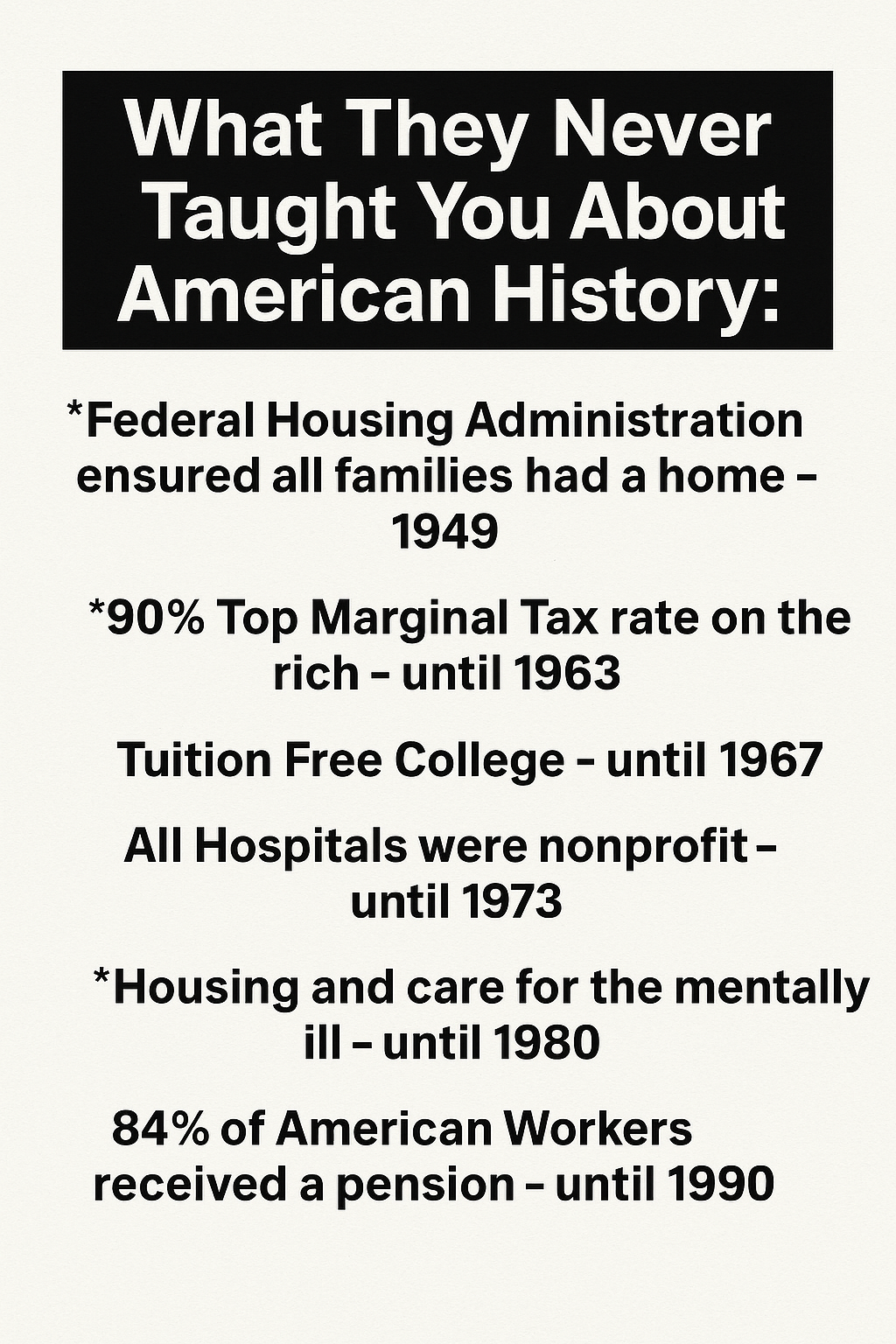
What This Image Shows
It lists several policies or social conditions from mid-20th-century America, suggesting that the U.S. once had strong social protections that have since eroded.
Breaking Down the Claims
- Federal Housing Administration Ensured All Families Had a Home (1949)
- Partly true, but simplified.
The FHA, created in 1934, expanded post-WWII, helping millions of families afford homes through mortgage guarantees.
Caveat: It heavily favored white, middle-class families and was complicit in redlining, excluding Black families from these benefits.
- Partly true, but simplified.
- 90% Top Marginal Tax Rate on the Rich (Until 1963)
- True, but with nuance.
From the 1940s to early 1960s, top marginal tax rates were 90% or higher. This applied only to income above a very high threshold. Rich people still used loopholes and deductions.
- True, but with nuance.
- Tuition-Free College (Until 1967)
- Partly true, depends on the state.
Public universities, especially in California and New York, offered tuition-free or nearly free college to in-state students.
Nationwide, costs were much lower than today, but not universally free everywhere.
- Partly true, depends on the state.
- All Hospitals Were Nonprofit (Until 1973)
- Exaggerated.
Many hospitals were nonprofit, especially religious or community-based ones, but for-profit hospitals existed before 1973.
What changed in the 1970s was the rise of corporatized, investor-owned hospitals, especially after Nixon’s HMO Act (1973).
- Exaggerated.
- Housing and Care for the Mentally Ill (Until 1980)
- Partly true, missing context.
Institutional care was widespread, but often criticized for abuse and neglect.
The deinstitutionalization movement began in the 1960s, but Reagan’s administration (1980s) slashed federal mental health funding, worsening the crisis.
- Partly true, missing context.
- 84% of American Workers Received a Pension (Until 1990)
- Unclear, exaggerated.
Pension coverage was higher in the mid-20th century, especially through union jobs, but 84% sounds inflated. By 1990, defined-benefit pensions were declining, replaced by 401(k)s and similar plans.
- Unclear, exaggerated.
Where These Ideas Come From
- Left-leaning historians, economists, and social justice advocates often use these facts (sometimes simplified) to highlight:
- Post-WWII America had strong social safety nets
- The rich paid more taxes
- Public services were more affordable
- Deregulation and privatization since the 1970s-80s eroded those protections
Sources Often Cited:
- U.S. Census & IRS tax records
- Historical studies on housing and redlining
- University tuition records
- Healthcare policy histories
- Labor Department pension data
- Books like The Shock Doctrine (Naomi Klein), Winner-Take-All Politics (Hacker & Pierson), or documentaries on American inequality
Bottom Line
The graphic reflects real trends but simplifies or romanticizes certain points. It’s meant to spark discussion about inequality, corporate greed, and the rollback of social programs.