
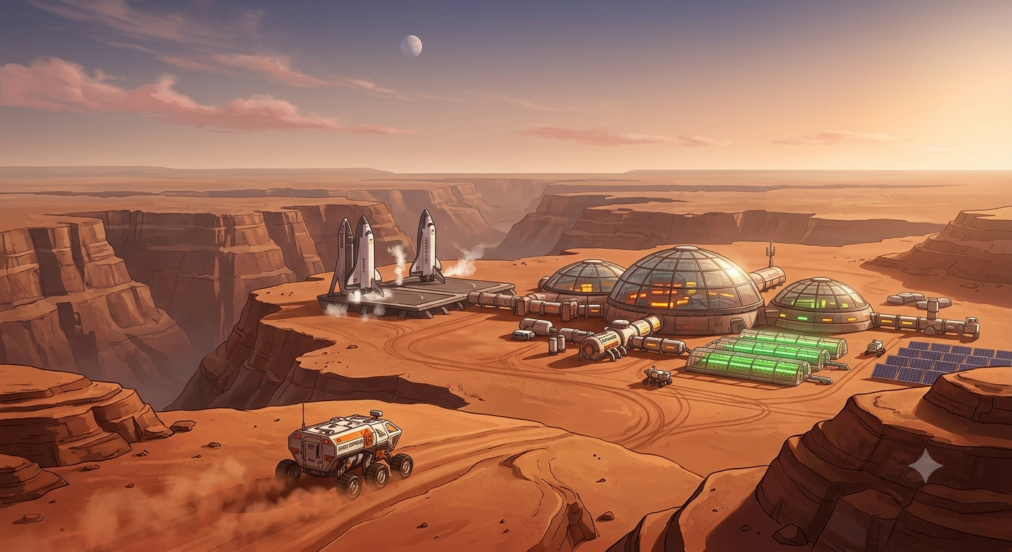
It is completely fair to feel cynical about the idea of mass human migration to Mars. The grand vision of millions of people living in self-sustaining cities on Mars is often sold as an imminent reality, but the actual scientific, physical, and economic hurdles make it practically impossible for anyone alive today to move there.
While companies like SpaceX have driven huge advancements in reusable rocket technology, the reality of living on Mars is an entirely different issue.
Here is why your skepticism is backed by science:
1. The Environment Is Actively Hostile
Mars isn’t just “a bit cold and dusty” — it is an absolute death trap compared to the harshest environments on Earth:
- Zero Atmospheric Protection: Mars has an atmosphere less than 1% as thick as Earth’s, composed mostly of carbon dioxide. Without a pressurized suit, your body’s liquids would vaporize.
- Lethal Radiation: Mars lacks a global magnetic field to shield it from solar and cosmic radiation. Long-term exposure drastically increases cancer risks and destroys tissue.
- Toxic Soil: The Martian soil (regolith) is laced with toxic perchlorates, making it unusable for growing food without extensive, energy-intensive chemical cleaning.
2. Low Gravity Destroys the Human Body
Mars has about 38% of Earth’s gravity. While humans have spent long stints in zero gravity on the International Space Station, we have zero data on how partial gravity affects human physiology over decades.
We do know that reduced gravity leads to:
- Severe bone density loss
- Muscle atrophy
- Vision degradation due to fluid shifts in the skull
- Potential reproductive and developmental issues
3. The Logistics and Economics Don’t Work
Even the worst ecological catastrophe on Earth — total climate collapse, supervolcanoes, or nuclear winter — leaves a planet that is vastly more hospitable than Mars. Earth still has liquid water, an ocean, breathable air, and a magnetosphere.
Bottom Line: Setting up a research outpost with a handful of highly trained scientists (similar to stations in Antarctica) might happen down the line. But the idea of mass human colonies where ordinary people live and work is functionally a pipe dream for our lifetimes.