
The story of the USS Forrestal (CV-59) is one of both tragedy and historical significance. Here’s a clear breakdown of the key events that led to the infamous fire aboard the ship and what became of the vessel afterwar
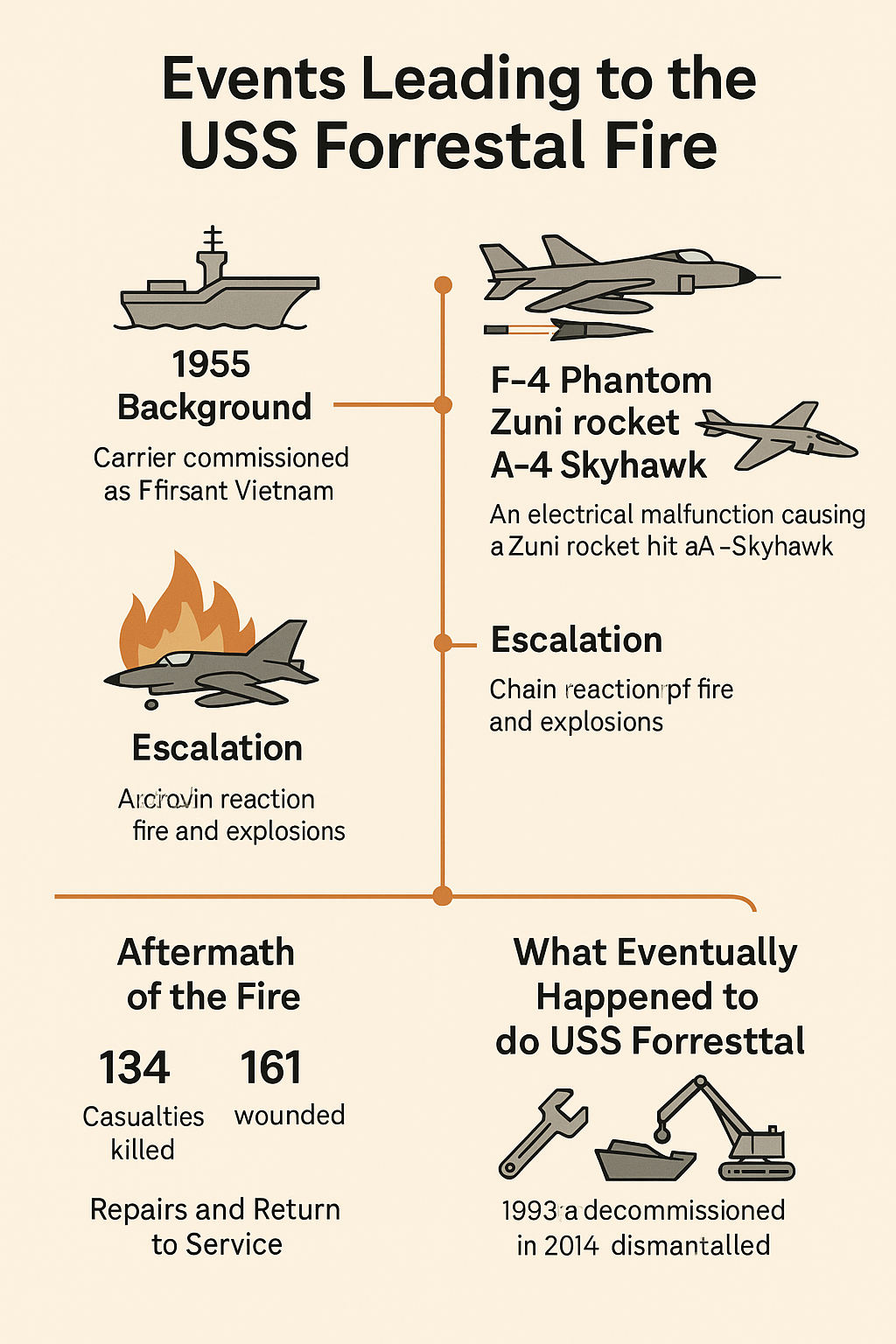
Events Leading to the USS Forrestal Fire
Background
- USS Forrestal was the first “supercarrier” of the U.S. Navy, commissioned in 1955.
- By 1967, she was operating in the Gulf of Tonkin off Vietnam, launching airstrikes during the Vietnam War.
The Incident: July 29, 1967
- The ship was preparing for a major airstrike. The flight deck was crowded with fully armed aircraft, fueled and loaded with ordnance.
- A McDonnell Douglas F-4 Phantom II was among those prepping. It was positioned near A-4 Skyhawks. One of these was piloted by Lt. Cmdr. John McCain (yes, that John McCain).
What Sparked the Disaster
- An electrical malfunction in the F-4 Phantom caused a Zuni rocket to accidentally fire across the flight deck.
- The rocket slammed into McCain’s A-4 Skyhawk, rupturing its fuel tank.
- Fuel spilled across the deck and ignited almost immediately, setting off a catastrophic chain reaction.
Escalation
- The fire spread rapidly across the deck, fueled by jet fuel and detonating ordnance.
- Several bombs, some of them unstable 1,000-pound WWII-era bombs, began to “cook off” from the heat.
- The explosions ripped through the flight deck, killing and wounding crew members who were trying to fight the fire.
Aftermath of the Fire
Casualties
- 134 sailors killed
- 161 wounded
- The disaster became one of the deadliest U.S. naval accidents since WWII.
Damage
- The flight deck was extensively damaged.
- 21 aircraft destroyed, many others damaged.
- Despite the devastation, the crew managed to contain the fires after hours of brutal firefighting.
What Eventually Happened to the USS Forrestal
Repairs and Return to Service
- After temporary repairs in the Philippines, Forrestal sailed to the U.S. for full restoration.
- She re-entered service in 1968, continuing operations for decades, participating in:
- Cold War exercises
- Mediterranean deployments
- Various NATO operations
Later Years
- Forrestal served until 1993, when she was decommissioned after nearly 40 years of service.
Final Fate
- After decommissioning, she sat in mothball status for years.
- In 2014, she was sold for scrap.
- The once-proud supercarrier was dismantled in Brownsville, Texas, bringing her long and storied career to an end.
Legacy
- The Forrestal disaster led to major changes in naval safety protocols. It also influenced damage control training. Furthermore, it changed the way ordnance is handled aboard carriers.
- The ship’s legacy is a cautionary tale. It is also a testament to the bravery of those who fought the flames that day.