Why It Was Needed!!!
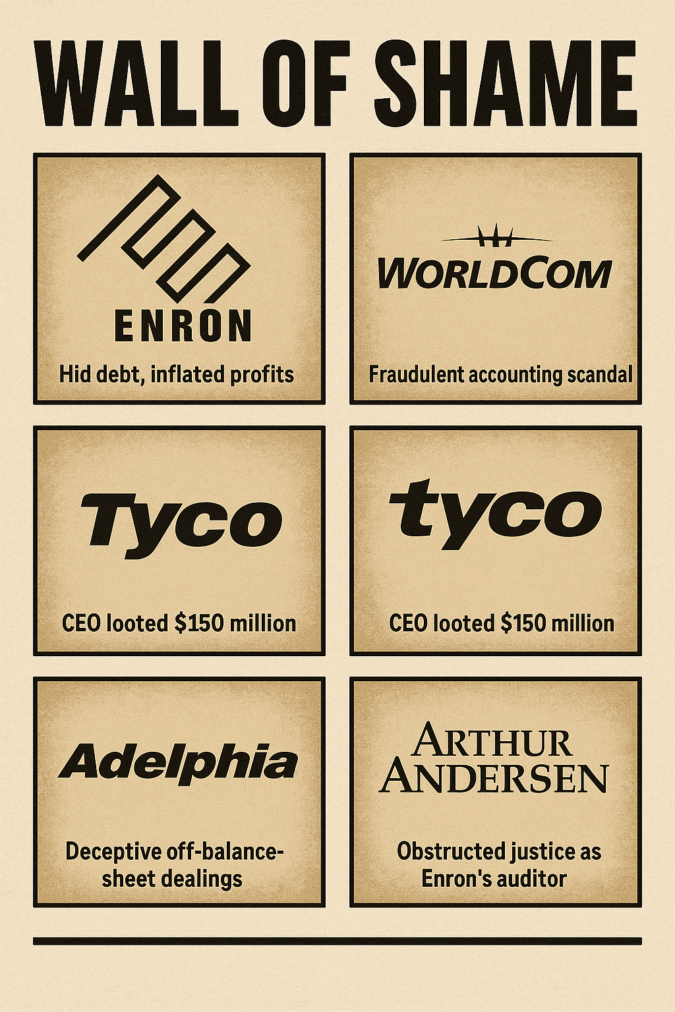
- Massive corporate scandals — Think Enron, WorldCom, Tyco. These companies cooked the books, hid losses, and inflated earnings. Investors were lied to, employees lost pensions, and markets lost confidence.
- Auditor conflicts of interest — Accounting firms like Arthur Andersen were making huge consulting fees. They earned these fees from the same companies they were supposed to audit objectively.
- Weak oversight — The SEC didn’t have the resources to catch fraud early. It lacked the necessary authority. Corporate boards often rubber-stamped whatever executives wanted.
- Investor confidence collapse — After the scandals, people didn’t trust the numbers in financial statements. That threatened the entire U.S. stock market’s credibility.
What It Was Meant to Do
- Make executives personally responsible — CEOs and CFOs must personally certify financial statements. This means they can’t claim ignorance if fraud is found.
- Tighten auditing standards — Created the Public Company Accounting Oversight Board (PCAOB) to regulate auditors.
- Strengthen internal controls — Section 404 requires companies to prove they have reliable systems to prevent and detect fraud.
- Increase penalties — Fraudulent financial reporting can now lead to criminal charges, big fines, and prison time.
Bottom Line
SOX wasn’t about adding red tape just for fun — it was about restoring trust in U.S. markets by making sure:
- The numbers you see are accurate.
- The people signing off on them can’t hide behind “I didn’t know.”
- Auditors work for truth, not for the executives they audit.
If it hadn’t passed, there was a real risk that both U.S. and global investors would pull back from American markets entirely.
If you want, I can also break down the biggest corporate scams that directly led to Sarbanes–Oxley. This way you can see exactly how bad it got before they passed it.
More information please
Alright. Here’s the rogue’s gallery of scandals so jaw-dropping. Congress basically said, “Okay, you children clearly can’t be trusted with crayons. You certainly can’t be trusted with billions of dollars.”
1. Enron (Houston, TX)
- What they did: Used “creative” accounting (special purpose entities) to hide billions in debt and inflate profits.
- How bad it got: Employees lost their pensions and life savings. Investors lost $74 billion. The stock went from $90 to $0 in about a year.
- Why it mattered: Their auditors (Arthur Andersen) signed off on everything. They did this because they were making fat consulting fees from Enron.
- SOX impact: Led to auditor independence rules and creation of the PCAOB.
2. WorldCom (Clinton, MS)
- What they did: Pretended ordinary operating expenses were capital investments to make their books look healthier. In other words — they called the electric bill “real estate development” to hide losses.
- How bad it got: $11 billion in fake accounting entries — the largest corporate fraud in U.S. history at the time.
- Why it mattered: Showed how easy it was to manipulate numbers if internal controls were weak.
- SOX impact: Inspired the Section 404 requirement for companies to have documented, tested internal controls.
3. Tyco International (Bermuda HQ, operations in U.S.)
- What they did: The CEO and CFO treated the company like a personal piggy bank. They gave $150 million in unauthorized bonuses. They made art purchases and even bought a $6,000 shower curtain on the company dime.
- How bad it got: Shareholders lost $100 billion in market value.
- Why it mattered: Corporate boards had no clue — or didn’t care — what executives were doing.
- SOX impact: Strengthened corporate governance and executive accountability.
4. Adelphia Communications (Coudersport, PA)
- What they did: The Rigas family (founders) hid $2.3 billion in company debt. They moved it into personal shell companies. They also used corporate money to buy golf courses. They paid personal expenses with it.
- How bad it got: Bankruptcy, thousands lost jobs, investors wiped out.
- Why it mattered: Showed how insider control and opaque financial statements could completely deceive the market.
- SOX impact: Added transparency and disclosure requirements.
5. Arthur Andersen LLP (Chicago, IL)
- What they did: As auditors for Enron and others, they shredded documents and turned a blind eye to fraudulent accounting.
- How bad it got: It was once one of the “Big Five” accounting firms. It collapsed entirely after being convicted of obstruction of justice.
- Why it mattered: Proved the need for an independent body to police auditors.
- SOX impact: PCAOB was created to oversee audit firms.
The Pattern That Broke the Camel’s Back
- Auditors weren’t independent.
- Boards were weak.
- Executives weren’t personally liable.
- Accounting loopholes made lying easy and legal-ish.
- Penalties were so light that fraud was basically worth the risk.