
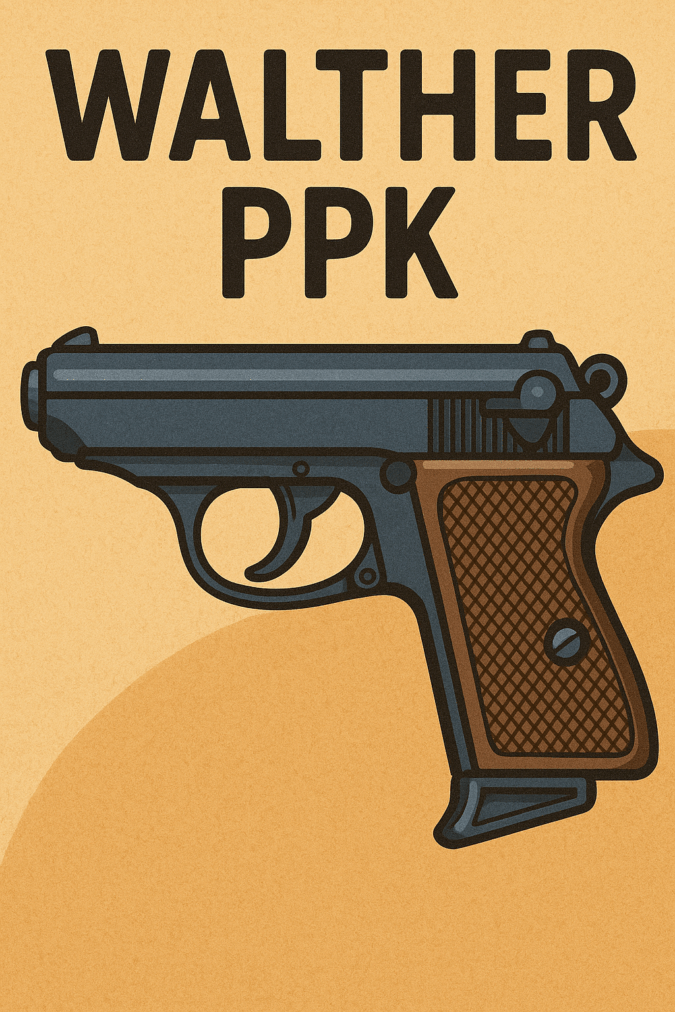
The PPK is a compact German semi-automatic pistol. It is known as Walther PPK (Polizeipistole Kriminalmodell). It was built in the 1930s as a smaller, concealable version of the Walther PP. It’s a small, blowback-operated DA/SA pistol famous for reliability, compactness, and — yes — being James Bond’s little friend. �
Wikipedia +1
Quick history & origin
Born in Germany. Walther developed the PP line (Polizeipistole) in 1929. The PPK (the “Kriminalmodell” or detective model) was the smaller, concealable variant that followed in the early 1930s. This is a German design and legacy, not English or Russian. �
Wikipedia
After WWII the design continued to be produced in various forms and places (Manurhin in France at one point, licensed runs, and later U.S. assembly for some models), but the lineage and original design are German. �
The Firing Line
Design & basics (what makes it a PPK)
Action: blowback, double-action/single-action (DA/SA).
Typical calibers: historically .32 ACP (.32 Auto) and .380 ACP (.380 Auto); smaller .22LR versions exist.
Capacity: small — usually 6–7 rounds depending on model (PPK vs PPK/S differences below).
Role: designed for concealed carry / plainclothes police / detectives — small size and smooth profile. �
www.waltherarms.com +1
Who makes PPKs today?
Walther Arms (the modern company) markets and manufactures current PPK and PPK/S models. In recent production, Walther has combined German slide manufacturing (Ulm) with some U.S.-made frames/components and U.S. assembly for certain models. In short: modern PPKs are from Walther (German design + modern manufacturing footprint). �
www.waltherarms.com +1
PPK vs. PPK/S (why you sometimes see two names)
The PPK/S is a hybrid. It was created so the smaller PPK could be sold into the U.S. after import rules changed in 1968. It uses the PPK slide/barrel on the PP’s longer grip frame. This change made it slightly larger. It also allowed one extra round in the magazine. This design was easier to import under the laws of the day. So PPK/S isn’t Russian or English either — just a practical American-market workaround based on a German design. �
The Truth About Guns
Are PPKs Russian or English? (short, bluntly)
Neither. The Walther PPK is German.
People often confuse it with other small pistols from other countries. For example, people often compare the Soviet Makarov PM, but it has a different design. It also originates from Russia / USSR. The Makarov is heavier, chambered in 9×18 Makarov, and was built for rugged simplicity; it’s not a Walther. �
Alien Gear Holsters +1
Why the PPK still matters today
Cultural: Bond iconography. The PPK is one of the most famous movie guns. It’s evergreen in pop culture. �
An Official Journal Of The NRA
Practical/market: There’s still demand for small, concealable pistols for deep conceal carry, historical collectors, and fans of classic designs; modern Walther PPK/PPK-S models are sold as carry/collector pieces. �
www.waltherarms.com +1
Collectible value & legacy: Original WW2-era and mid-century PPKs are collector pieces; modern reissues blend heritage with updated manufacturing and safety/ergonomics. �
True Gun Value +1
Practical note (safety & legality)
If you’re asking about owning or carrying one: laws vary wildly by country and U.S. state. Whether a PPK is a great carry gun is subjective — it’s small and concealable, but small = snappy recoil, limited capacity, and more challenging sights. Always follow local laws, safe-storage rules, and training. (I can’t advise you on how to obtain or modify firearms; for that, check local regulations and certified instructors.)
TL;DR (for scanners)
Walther PPK = German compact pistol (Polizeipistole Kriminalmodell). Not Russian or English. �
Wikipedia
Modern PPK/PPK-S are produced by Walther Arms with German heritage plus modern manufacturing/assembly. �
www.waltherarms.com
Often confused with the Soviet Makarov, but they’re different guns from different countries.